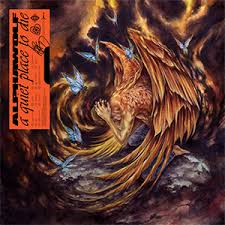
Few Deathcore bands can create a seamless and substantial record without using symphonic and melodic elements. The first band that comes to mind is Australia’s own Alpha Wolf. Their album A Quiet Place to Die merges Nu-Metal, Hardcore, Metalcore, and Deathcore to create an attitude-filled listening experience. To properly understand the effectiveness of the record, listeners should experience the album front to back, and who is best to do it with, especially me.
“A Quiet Place to Die”: 4
The opening to the album, and self-titled track, begins with a perfect amount of atmosphere and punch. I think it really establishes their approach to music, especially with the application of newer Hardcore. Their sound on the album is reminiscent of Code Orange, Harm’s Way, and even a clearer version of END. Vocalist Lochie Keogh has a simplistic scream, but with the combination of the heavier focus on style, he fits perfectly into the mold. Sabian Lynch and Scottie Simpson’s guitarwork drives the atmospheric parts of the song.
“Creep”: 3
One of the only weaker songs on the album, “Creep,” has an ambivalent rating in my head, since it seems to be recycled from the previous track’s ontology. Not to say it’s bad, but I just don’t understand it as much as the other tracks. I’m sure some out there have a better understanding and an ear for this side of the genre. It is a reflective track about the frustrations and betrayals the band experienced while growing up in the music scene. The lyrics are a cathartic expression of pent-up emotions from navigating the politics and difficulties within the heavy music community, especially in the face of a bleak future for live music at the time.
“Golden Fate; Isolate”: 4
Picking back up the pace, this track is in your face and unrelenting. It’s a more groovier approach to Hardcore takes on a more Kublai Khan TX sense of the scene. Lynch and Simpson shine with the help of Mitch Fogarty on drums. I can’t do Keogh justice on his lyrical mastery and vocals, so here’s a quick excerpt of the song and its meaning on behalf of Simpson. “The third and final chapter in the ‘Golden Fate’ series speaks more affronted than before. People deal with suicide in a variety of ways: the grieving, guilt, and anger. When faced with the death of someone you love, no one knows how they’re meant to feel.”
“Akudama”: 5
Listeners finally come upon one of the most fundamentally mastered sides of Alpha Wolf, and possibly the entirety of A Quiet Place to Die. It’s fun, in your face, and groovy. The number of times I have caught myself dancing to this track is seemingly problematic. Keogh’s vocals are pure testosterone-filled. The grooviness of lynch’s and Simpson’s riffs and breakdowns is a chef’s kiss. “Akudama” is an uplifting anthem about brushing aside those who have wronged another and moving on to improve the living conditions of oneself, physically and upstairs in the mind.
“Acid Romance”: 4
This is the first huge delve into the side of Deathcore, and it is near-perfection. I always felt that this track should have been the follow-up to the self-titled track instead of “Creep.” The scooped mids provide a familiar feeling, alongside the groove-oriented approach of Lynch and Simpson. The lulls in a normal Deathcore track are filled with an atmosphere that builds in this track. “Acid Romance” feels like an old-school track with the intensity, and the newer parts of the scene, using common elements in a heavily substantial way, to some extent, better than their contemporaries. The track covers a toxic relationship, however, not in the eyes of a victim, but of someone who is acting on violence as well.
“Rot in Pieces”: 4
Continuing, Alpha Wolf pushes further with a jam-packed track, filled with non-stop action. The track is best described as a bridge from “Akudama” to the previous track, “Rot in Pieces.” The punchier riffs make a return, without the groovier side of Lynch and Simpson. Fogarty’s placement in the drum mix substitutes, even adding in a Hardcore stylization to the track. By this time in the tracklist, listeners get to the part of the album where Keogh’s heart-on-sleeve philosophy starts to shine through.
“Bleed 4 You(Feat.Lizi Blance)”: 5
Honestly, after the past couple of masterpieces, I wasn’t expecting anything too melodic. This is definitely where the Melacore/Deathcore side of Alpha Wolf truly shines in many factors. Keogh’s vocals soar and create a diverse sound, almost to a more streamlined version of Draconian, with Lizi Blanco splitting the melodic groupings up even more. Lynch and Simpson apply an interesting take on the Metalcore structure with dissonant guitars. This is a reflection of a relationship that was made in grief and times of trouble, and how it blossomed due to desperation or in clarity.
“Ultra-Violet Violence”: 4
Advancing onward, they break out into a full onslaught of Nu-Metal. Simpson and Lynch bring back the punch of the top half of the album, with a more methodical approach. “Ultra-Violet Violence” lies between the more contemporary mid-section of the tracklist, with the aforementioned Nu-Metal/Hardcore aspects of the first few tracks. Lyrically, it is a visceral depiction of a family member having a stress-induced seizure.
“The Mind Bends to a Will of Its Own”: 5
Returning to the more melodic chops of Simspn and Lynch, they take the approach from the chorus in “Bleed 4 You” and flesh it out into a mere power ballad. Fogarty’s drums lead the melody, oddly enough, with his methodical playing and the position in the mix. Keogh reaches his zenith of emotion in a seemingly beautiful display. “The Mind Bends to a Will of Its Own” covers the mind-consuming nature of mental illness, and the loss of one’s self and their own control.
“Restricted (R18+)”: 5
Talking about coming out of left field. Alpha Wolf fully reintroduces the basic blueprints of Deathcore structure with dynamic and effective guitarwork on behalf of Lynch and Co. The familiar chugging with cool licks to break up the monotony helps listeners not get musical fatigue. It also helps Fogarty to flex his proverbial drum muscles, which again fails to not to be masterful. The track is an illustration of the profound emotional turmoil of bearing the burden of a loved one’s abuse and the consuming desire for brutal revenge against the perpetrator. It’s visceral and shows the constant spiral into stronger beckoning. It’s hate-filled, to the point that some of the lyrics I wouldn’t say to my worst enemies.
“Don’t Ask…”: 4
Originally, I felt the previous two tracks would have been fitting ends to the album. However, listening to this end was by far the best. The combination of all the aspects comes into one full four minutes. Everything is atmospheric and filled with a lot of emotion. It’s a satisfying end to one of the most dynamic Deathcore albums of the 20s and possibly the entire sub-genre.
Overall, this album creates many pillars of Metal, each of these are wishy-washy on a substantial level. However, Alpha Wolf breaks down each of these and mixes some aspects for a perfect production of each subgenre. Where most metal (especially the extreme side of it) tends to have a black and white approach to genres, Alpha Wolf is a once-in-a-generation band to give listeners a monochromatic experience, delving into multiple of Metal’s great genres.